Double Eyelid Surgery in Korea
Natural Asian Eyelid Surgery by Dr. Ahn Sung Min
Double eyelid surgery in Korea creates a defined upper eyelid crease that makes the eyes appear clearer, more balanced, and naturally refreshed. At Ahn Sung Min Plastic Surgery Clinic, Dr. Ahn Sung Min selects the most appropriate surgical technique based on eyelid thickness, fat volume, skin condition, eye-opening strength, and desired crease shape. The goal is a personalized result that complements the patient’s natural facial features.
Double Eyelid Surgery in Korea
Double eyelid surgery creates or improves the upper eyelid crease.
The procedure is not simply about making the eyes look larger. A successful result should improve eyelid balance, preserve natural movement, and create a crease that suits the patient’s eye shape and overall facial proportions.
Customized Eyelid Surgery by Dr. Ahn Sung Min
Dr. Ahn Sung Min evaluates each patient’s eyelid anatomy before recommending a surgical plan.
The examination includes:
- Eyelid skin thickness
- Upper eyelid fat volume
- Skin elasticity
- Existing eyelid crease
- Eyelid-opening strength
- Brow position
- Eye symmetry
- Previous eyelid surgery
- Preferred crease height and shape
The surgical method and design are customized rather than applying the same crease to every patient.
Types of Double Eyelid Surgery
Non-Incisional Double Eyelid Surgery
The non-incisional method creates a crease using small entry points and buried sutures.
It may be suitable for patients with thin eyelids, minimal fat, and little excess skin. Recovery is generally shorter than with incisional surgery.
Partial-Incision Double Eyelid Surgery
The partial-incision method uses several small openings along the planned crease.
It allows stronger fixation and limited fat removal while involving less tissue dissection than a full incision.
Incisional Double Eyelid Surgery
The incisional method allows direct adjustment of eyelid skin, fat, muscle, scar tissue, and internal fixation.
It may be recommended for thick eyelids, excess skin, ptosis, revision cases, or patients who need more extensive correction.
Choosing the Right Eyelid Crease
Common double eyelid crease designs include:
- Tapered crease
- In-out crease
- Parallel crease
- Low natural crease
- More defined crease
The ideal crease depends on the patient’s natural eye shape, inner corner anatomy, eyelid thickness, brow position, and aesthetic goals.
A crease that is too high or too deeply fixed may appear unnatural.
Can Ptosis Correction Be Combined?
Yes.
Some patients have weak eyelid-opening muscles that make the eyes look tired, heavy, or uneven. They may also raise their eyebrows or use their forehead muscles to open their eyes.
When ptosis is present, ptosis correction may be combined with double eyelid surgery to improve both function and appearance.
Who Is a Good Candidate?
Double eyelid surgery may be suitable for patients who want to improve:
- Single eyelids
- Weak or disappearing creases
- Uneven double eyelids
- Multiple eyelid folds
- Puffy upper eyelids
- Heavy or tired-looking eyes
- Mild excess eyelid skin
- Eyelid asymmetry
- Previous unsatisfactory eyelid surgery
The most appropriate procedure is determined after an examination.
Natural Double Eyelid Surgery
A natural result should look balanced when the eyes are open, closed, and moving.
Dr. Ahn Sung Min focuses on conservative crease height, smooth fixation, careful tissue preservation, and appropriate symmetry. Excessive removal of eyelid fat or skin is avoided because it may create a hollow, deep, or aged appearance.
Double Eyelid Revision Surgery
Revision surgery may be considered when a previous procedure has caused:
- A crease that is too high or too low
- Deep or unnatural fixation
- Multiple folds
- Uneven eyelids
- Visible scarring
- A loose or disappearing crease
- Residual puffiness
- Incomplete ptosis correction
Revision surgery requires detailed evaluation of scar tissue, remaining skin, eyelid volume, and muscle function.
Recovery After Double Eyelid Surgery
Recovery depends on the surgical technique and amount of correction.
Swelling and bruising are common during the first several days. The crease may initially look higher or stronger than expected but gradually becomes softer as swelling decreases.
Non-incisional surgery generally has a shorter recovery period, while incisional and revision procedures may require more time for the final result to settle.
International Patients
International patients may submit clear photographs for a preliminary online consultation.
Recommended photographs include:
- Eyes open naturally
- Eyes gently closed
- Looking upward
- Front view
- Side or three-quarter view
Patients should also provide their age, medical history, previous surgery history, current medications, and preferred eyelid style.
The final surgical plan and quotation are confirmed after an in-person consultation.
Why Choose Ahn Sung Min Plastic Surgery Clinic?
Ahn Sung Min Plastic Surgery Clinic provides customized double eyelid surgery based on each patient’s anatomy and goals.
The clinic emphasizes:
- Specialized eyelid surgery
- Personalized crease design
- Natural-looking results
- Conservative tissue adjustment
- Functional eyelid evaluation
- Careful symmetry assessment
- Primary and revision eyelid surgery
- International patient support
Frequently Asked Questions
What is double eyelid surgery?
Double eyelid surgery creates or improves an upper eyelid crease to enhance eye definition and balance.
Which double eyelid technique is best?
The best technique depends on eyelid thickness, fat volume, excess skin, muscle strength, previous surgery, and desired results.
What is the difference between non-incisional and incisional surgery?
Non-incisional surgery uses buried sutures without a full incision. Incisional surgery allows more extensive adjustment of skin, fat, muscle, and scar tissue.
What is partial-incision double eyelid surgery?
Partial-incision surgery uses several small openings to create stronger fixation and allow limited fat removal.
Will the result look natural?
The goal is to create a crease that complements the patient’s natural eye shape and facial proportions. Appropriate crease height and tissue preservation are important.
Can I choose the crease shape?
Yes. Patients may discuss tapered, in-out, parallel, or low natural crease designs during consultation.
Can eyelid fat be removed?
Excess fat may be conservatively removed when necessary. Excessive fat removal should be avoided because it can create hollow-looking eyes.
Can ptosis correction be combined?
Yes. Ptosis correction may be recommended when weak eyelid-opening muscles cause heavy, tired, or uneven-looking eyes.
Can uneven eyelids be corrected?
Double eyelid surgery may improve asymmetry, although perfect symmetry cannot be guaranteed because the eyes are naturally different.
How long does swelling last?
Most noticeable swelling improves during the first one to two weeks. Minor swelling may continue for several weeks or months.
Will there be a visible scar?
Scarring depends on the surgical method. Incisional scars are placed within the eyelid crease and generally become less noticeable over time.
How long do the results last?
Results may be long-lasting, although the eyelids continue to change with natural aging. Non-incisional creases may have a greater chance of loosening.
Can previous double eyelid surgery be revised?
Yes. Revision surgery may improve high, low, uneven, loose, scarred, or unnatural eyelid creases.
How long should international patients stay in Korea?
The recommended stay depends on the surgical method and postoperative follow-up schedule.
Is an online consultation available?
Yes. International patients may submit photographs, medical history, previous surgery details, and their preferred eyelid style for a preliminary assessment.
Double Eyelid Surgery before & after
Unretouched photos of real patients, operated by board-certified plastic surgeon Dr. Ahn Sung Min in Seoul. See the full gallery of 7 cases.
 Incisional double eyelid surgery
 Incisional double eyelid surgery
 Incisional double eyelid surgery
 Incisional double eyelid surgery

About the surgeon
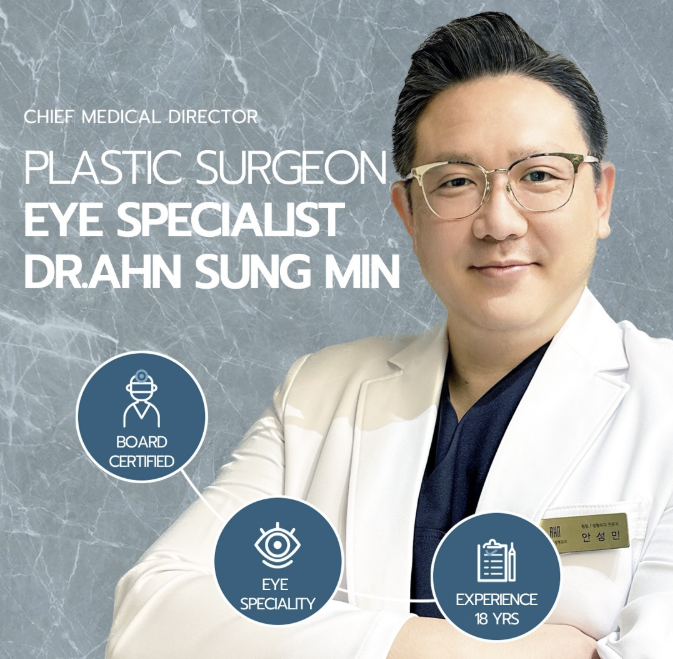
Korean board-certified plastic surgeon trained at Yonsei University College of Medicine, and a full member of the Korean Society of Plastic and Reconstructive Surgeons, the Korean Society for Aesthetic Plastic Surgery and the Korean Society for Microsurgery. Representative Director of Ahn Sung Min Plastic Surgery, an eye-only clinic in Seoul.
- 4,000+ eyelid procedures
- 18 yrs eye surgery only
- 2 a day maximum operations
- 1 surgeon from consultation to follow-up
Last updated October 2026. This page gives general information about Double Eyelid Surgery in Korea and is not a substitute for an in-person consultation. Individual results vary. Contact the clinic