Partial Incision Double Eyelid Surgery in Korea |
Natural Double Eyelid Surgery by Dr. Ahn Sung Min
Partial incision double eyelid surgery in Korea combines the advantages of non-incisional and full incisional techniques. At Ahn Sung Min Plastic Surgery Clinic, Dr. Ahn Sung Min uses small incisions to create a natural, stable eyelid crease while selectively removing excess fat when needed. The procedure is ideal for patients who require more than a suture method but do not need a full incision.
Partial Incision Double Eyelid Surgery in Korea
Partial incision double eyelid surgery creates a defined eyelid crease through several small incisions rather than a full-length incision.
This technique allows limited removal of excess fat and stronger internal fixation than the non-incisional method while minimizing tissue disruption compared with a full incisional procedure. The surgical approach is customized according to each patient's eyelid anatomy, skin thickness, fat volume, and desired crease shape.
Natural Double Eyelid Surgery by Dr. Ahn Sung Min
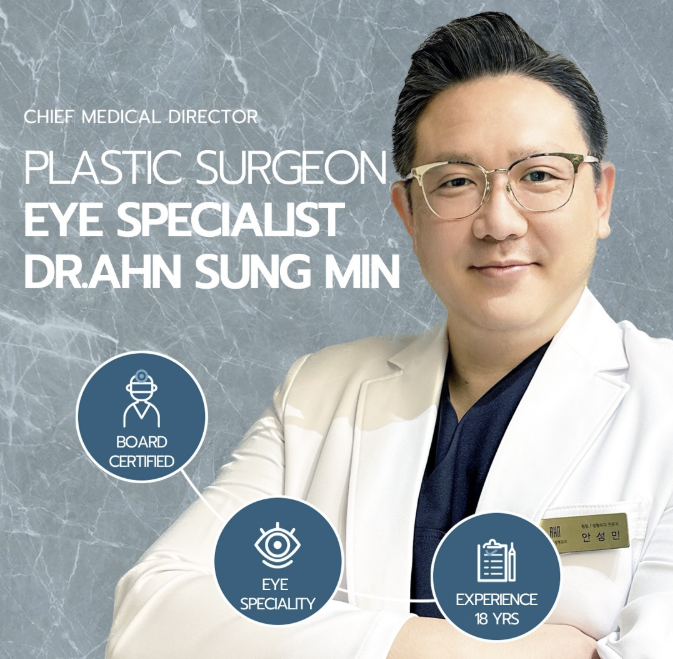
Dr. Ahn Sung Min designs every double eyelid based on the patient's facial proportions instead of creating identical crease heights for every patient.
During consultation, he evaluates:
- Eyelid thickness
- Eyelid fat volume
- Skin elasticity
- Natural eyelid crease
- Eye symmetry
- Eyelid-opening strength
- Brow position
- Preferred crease design
The goal is to achieve a balanced, natural-looking double eyelid that complements the patient's facial features.
How Does Partial Incision Surgery Work?
Several small openings are made along the planned eyelid crease. Through these openings, excess fat may be conservatively removed when necessary, and the eyelid tissues are securely fixed to create a stable crease.
Because the incisions are smaller than those used in a full incisional procedure, recovery may be faster while still providing stronger fixation than the buried suture technique.
Benefits of Partial Incision Double Eyelid Surgery
Potential benefits include:
- Smaller incisions than full incisional surgery
- Stronger crease fixation than the non-incisional method
- Limited fat removal when appropriate
- Natural-looking crease design
- Minimal visible scarring
- Moderate recovery period
- Long-lasting results for suitable candidates
The final outcome depends on the patient's anatomy and healing process.
Who Is a Good Candidate?
Partial incision double eyelid surgery may be suitable for patients who have:
- Mild to moderate eyelid thickness
- Mild excess eyelid fat
- Minimal excess skin
- An unstable natural crease
- Mild eyelid asymmetry
- Previous non-incisional surgery that has loosened
- A desire for stronger fixation without a full incision
Patients with significant loose skin, severe ptosis, or very thick eyelids may benefit more from a full incisional procedure.
Partial Incision vs. Other Double Eyelid Techniques
Non-incisional surgery offers the fastest recovery but is generally best suited for thinner eyelids with minimal fat.
Partial incision surgery provides a balance between recovery and stability by allowing limited tissue adjustment through small incisions.
Full incisional surgery offers the greatest flexibility for removing excess skin, adjusting fat, correcting ptosis, and treating thicker or more complex eyelids.
The most appropriate technique depends on each patient's anatomy rather than personal preference alone.
Can Ptosis Correction Be Combined?
Yes. If weak eyelid-opening muscles contribute to heavy or sleepy-looking eyes, ptosis correction may be recommended together with partial incision double eyelid surgery.
A functional eyelid examination helps determine whether additional muscle correction is necessary.
Recovery After Partial Incision Surgery
Swelling and mild bruising are common during the first several days after surgery.
Most swelling gradually improves over the first one to two weeks, while the eyelid crease continues to soften over the following weeks. Recovery varies according to individual healing and the amount of tissue adjustment performed.
International Patients
International patients may submit clear photographs for an initial online consultation before traveling to Korea.
Recommended photographs include:
- Eyes open
- Eyes naturally closed
- Looking upward
- Side or three-quarter view
The final surgical recommendation is confirmed after an in-person examination.
Why Choose Ahn Sung Min Plastic Surgery Clinic?
Ahn Sung Min Plastic Surgery Clinic provides customized eyelid surgery designed around each patient's anatomy and aesthetic goals.
The clinic emphasizes:
- Specialized eyelid surgery
- Personalized crease design
- Natural-looking results
- Conservative tissue adjustment
- Careful symmetry evaluation
- Functional eyelid assessment
- International patient support
Frequently Asked Questions
What is partial incision double eyelid surgery?
It is a technique that creates a double eyelid using several small incisions instead of a full-length incision, allowing stronger fixation and limited fat removal when necessary.
How is partial incision different from non-incisional surgery?
Partial incision allows direct access to eyelid fat and stronger tissue fixation, while non-incisional surgery relies only on buried sutures.
How is partial incision different from full incisional surgery?
Partial incision uses smaller openings and generally involves less tissue dissection. Full incisional surgery allows greater adjustment of excess skin, fat, and muscle.
Who is a good candidate?
Patients with mild to moderate eyelid thickness, small amounts of fat, minimal excess skin, and a desire for stronger fixation than the suture method may be good candidates.
Will there be a visible scar?
The procedure uses several small incisions that are positioned within the eyelid crease. As healing progresses, the scars generally become less noticeable.
Can eyelid fat be removed?
Yes. Small amounts of excess fat may be conservatively removed when appropriate to improve eyelid definition.
Can ptosis correction be combined?
Yes. If weak eyelid-opening muscles are present, ptosis correction may be performed at the same time after evaluation.
Is the result permanent?
The crease is generally more stable than the non-incisional method, although natural aging and individual healing may influence long-term appearance.
How long does swelling last?
Most noticeable swelling improves during the first one to two weeks, while subtle swelling may continue for several weeks.
Can previous non-incisional surgery be revised?
Yes. Partial incision surgery may be an option for patients whose previous suture-based crease has loosened or disappeared.
When can I return to normal activities?
Most patients can gradually resume daily activities within several days, depending on swelling and individual recovery. Strenuous exercise should be avoided until approved by the surgeon.
How long should international patients stay in Korea?
The recommended stay depends on the postoperative follow-up schedule and individual healing. The clinic will advise the appropriate length of stay after consultation.
Is an online consultation available?
Yes. International patients may submit photographs, medical history, previous eyelid surgery history, and their desired crease style for a preliminary assessment before visiting Korea.