Revision Double Eyelid Surgery in Korea
Expert Eyelid Revision by Dr. Ahn Sung Min
Revision double eyelid surgery in Korea corrects unsatisfactory results from previous eyelid procedures while restoring a natural appearance and proper eyelid function. At Ahn Sung Min Plastic Surgery Clinic, Dr. Ahn Sung Min carefully evaluates scar tissue, eyelid anatomy, and muscle function before creating a personalized revision plan. Every revision surgery is tailored to the patient's unique condition rather than following a standard approach.
Revision Double Eyelid Surgery in Korea
Revision double eyelid surgery is performed to improve the appearance or function of eyelids after previous surgery.
Unlike primary eyelid surgery, revision procedures require careful evaluation of scar tissue, remaining skin, eyelid volume, previous fixation methods, and muscle function. Every revision case presents unique challenges, making individualized surgical planning essential.
Revision Eyelid Surgery by Dr. Ahn Sung Min
Dr. Ahn Sung Min performs a detailed examination before recommending revision surgery.
The evaluation includes:
- Previous surgical technique
- Scar tissue
- Remaining eyelid skin
- Eyelid fat volume
- Eyelid-opening strength
- Existing crease position
- Eye symmetry
- Brow position
- Overall facial balance
The objective is to improve both eyelid appearance and function while preserving as much healthy tissue as possible.
Common Reasons for Revision Surgery
Revision double eyelid surgery may be recommended for:
- Crease that is too high
- Crease that is too low
- Multiple eyelid folds
- Uneven double eyelids
- Disappearing or loose crease
- Visible scarring
- Hollow upper eyelids
- Puffy or heavy eyelids
- Incomplete ptosis correction
- Unsatisfactory cosmetic results after previous surgery
The appropriate solution depends on the underlying cause rather than the visible appearance alone.
How Is Revision Surgery Different?
Revision surgery is generally more complex than first-time double eyelid surgery.
Scar tissue, altered anatomy, previous tissue removal, and weakened eyelid structures may limit surgical options. The procedure often requires meticulous tissue handling and conservative correction to achieve the safest and most natural outcome.
Can a High Double Eyelid Crease Be Lowered?
Yes, in selected patients.
An excessively high crease may make the eyes appear surprised, unnatural, or older. Depending on the amount of remaining skin, scar tissue, and eyelid condition, the crease may be repositioned to create a lower and more balanced appearance.
Not every high crease can be lowered to the same extent, and realistic expectations are important.
Correcting Multiple or Uneven Creases
Multiple folds or asymmetrical eyelids may develop because of uneven fixation, scar formation, or previous surgical changes.
Revision surgery aims to create a smoother, more stable eyelid crease while improving symmetry as much as possible. Perfect symmetry cannot be guaranteed because natural anatomical differences remain.
Can Ptosis Be Corrected During Revision Surgery?
Yes.
Some patients continue to experience heavy, sleepy-looking eyes because the original ptosis was not corrected or because the eyelid-opening muscles remain weak.
When appropriate, ptosis correction may be combined with revision surgery to improve eyelid function and eye-opening.
Who Is a Good Candidate?
Revision surgery may be appropriate for patients who have:
- Unsatisfactory previous eyelid surgery
- High or low eyelid creases
- Uneven eyelids
- Multiple folds
- Loose or disappearing creases
- Visible scars
- Persistent puffiness
- Eyelid asymmetry
- Residual ptosis
- Functional eyelid concerns
A consultation is necessary to determine whether further surgery is recommended.
Recovery After Revision Double Eyelid Surgery
Recovery varies depending on the complexity of the revision procedure.
Swelling and bruising may last longer than after primary surgery because of existing scar tissue. The eyelid crease may initially appear firm or uneven before gradually softening during healing.
Final refinement may continue for several months.
International Patients
International patients may submit clear photographs before traveling to Korea.
Recommended photographs include:
- Eyes open naturally
- Eyes gently closed
- Looking upward
- Front view
- Side or three-quarter view
Previous surgical records or photographs may also be helpful when available.
The final revision plan is confirmed after an in-person examination.
Why Choose Ahn Sung Min Plastic Surgery Clinic?
Ahn Sung Min Plastic Surgery Clinic provides individualized revision eyelid surgery based on detailed anatomical evaluation.
The clinic emphasizes:
- Specialized eyelid surgery
- Experience with complex revision cases
- Personalized surgical planning
- Conservative tissue preservation
- Functional eyelid assessment
- Natural-looking correction
- Primary and revision surgery
- International patient support
Frequently Asked Questions
What is revision double eyelid surgery?
Revision double eyelid surgery corrects cosmetic or functional concerns following previous eyelid surgery by improving the crease, symmetry, eyelid function, or overall appearance.
Why do patients need revision surgery?
Common reasons include high or low creases, multiple folds, asymmetry, disappearing creases, scarring, residual puffiness, incomplete ptosis correction, or dissatisfaction with the previous result.
Is revision surgery more difficult than first-time surgery?
Yes. Scar tissue, previous tissue removal, and altered eyelid anatomy generally make revision surgery more technically demanding than primary eyelid surgery.
Can a high eyelid crease be lowered?
In many cases, yes. The possibility depends on the remaining skin, scar tissue, previous surgical technique, and overall eyelid condition.
Can asymmetrical eyelids be corrected?
Revision surgery may improve eyelid symmetry, although perfect symmetry cannot be guaranteed because natural differences between the eyes remain.
Can disappearing double eyelids be repaired?
Yes. A loose or disappearing crease may be revised by creating more stable fixation when appropriate.
Can ptosis correction be combined?
Yes. If weak eyelid-opening muscles are contributing to heavy or sleepy-looking eyes, ptosis correction may be performed during revision surgery.
Can scars from previous surgery be improved?
Many visible scars can be improved during revision surgery, although complete scar removal is not always possible.
Which surgical method is used for revision surgery?
Depending on the patient's condition, revision may involve a non-incisional, partial-incision, or full incisional approach. The technique is selected individually.
How long does swelling last?
Swelling may persist longer than after primary surgery because revision procedures often involve scar tissue. Improvement continues gradually over several weeks and months.
Can revision surgery restore a natural appearance?
The goal is to create a more balanced and natural-looking eyelid while preserving eyelid function. The achievable improvement depends on the condition of the tissues and previous surgery.
How long should I wait before revision surgery?
Patients are generally advised to wait until healing is complete before considering revision surgery, unless an earlier procedure is medically necessary. The surgeon will determine the appropriate timing after evaluation.
How long should international patients stay in Korea?
The recommended stay depends on the complexity of the revision procedure and postoperative follow-up schedule.
Is an online consultation available?
Yes. International patients may submit photographs, previous surgical history, and their concerns for a preliminary assessment before visiting Korea.
Revision Eye Surgery before & after
Unretouched photos of real patients, operated by board-certified plastic surgeon Dr. Ahn Sung Min in Seoul. See the full gallery of 25 cases.
 Revision eyelid surgery – restoring stability after multiple previous operations
 Scar and adhesion revision after previous eyelid surgery
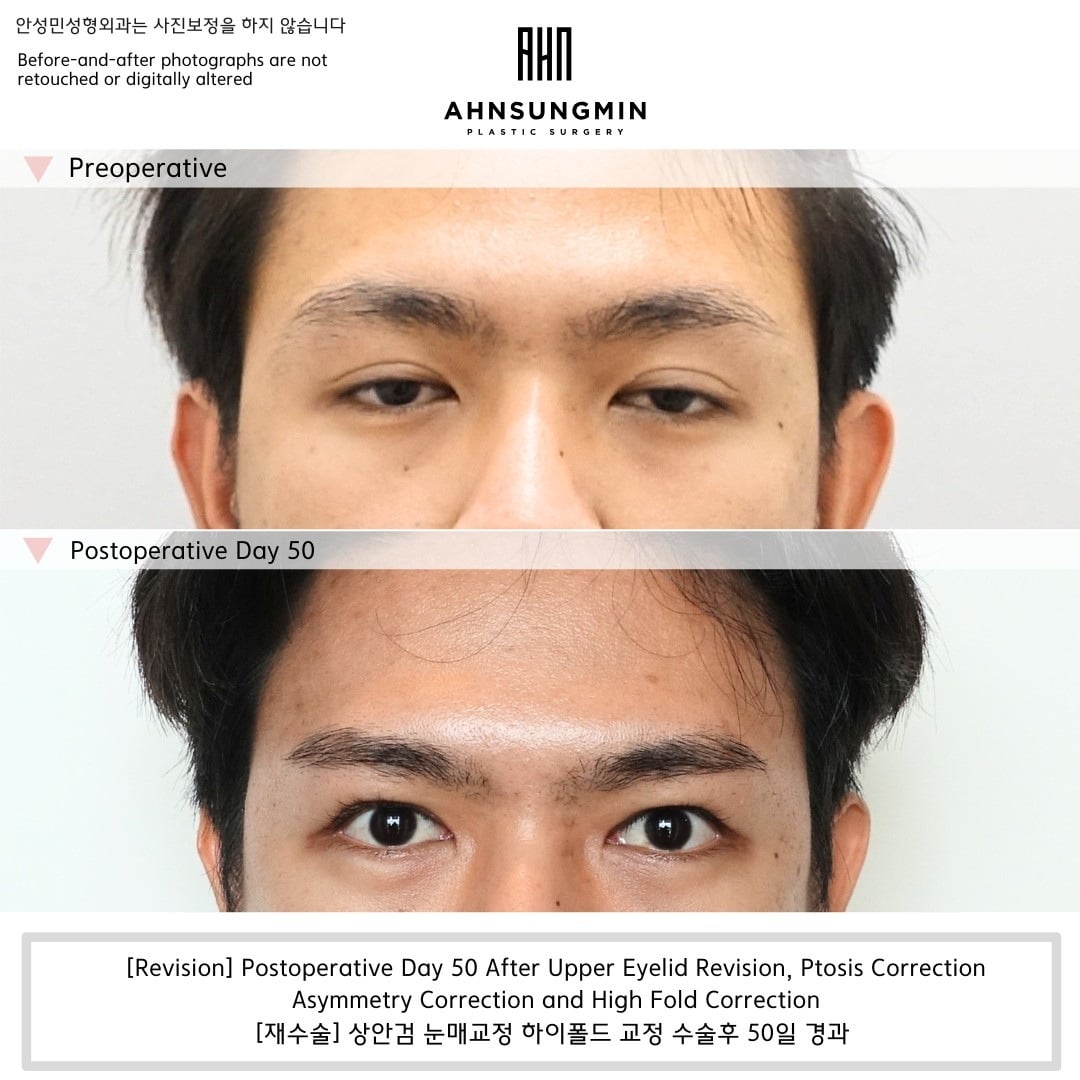 Revision ptosis correction with asymmetry and high-fold correction – day 50
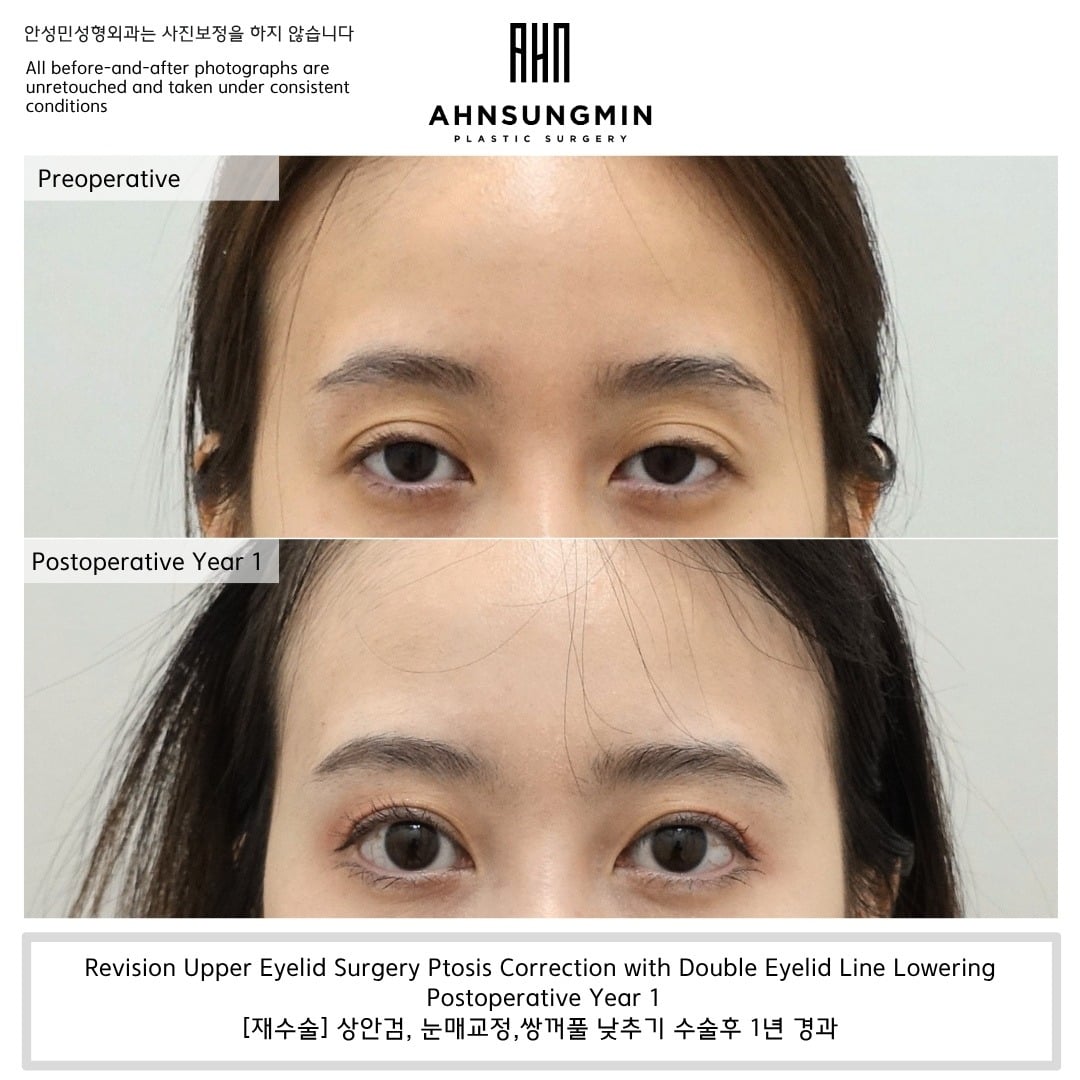 Revision upper blepharoplasty, ptosis correction and crease lowering – 1 year

About the surgeon
Korean board-certified plastic surgeon trained at Yonsei University College of Medicine, and a full member of the Korean Society of Plastic and Reconstructive Surgeons, the Korean Society for Aesthetic Plastic Surgery and the Korean Society for Microsurgery. Representative Director of Ahn Sung Min Plastic Surgery, an eye-only clinic in Seoul.
- 4,000+ eyelid procedures
- 18 yrs eye surgery only
- 2 a day maximum operations
- 1 surgeon from consultation to follow-up
Last updated October 2026. This page gives general information about Revision Double Eyelid Surgery in Korea and is not a substitute for an in-person consultation. Individual results vary. Contact the clinic