Revision Eye Surgery Korea |
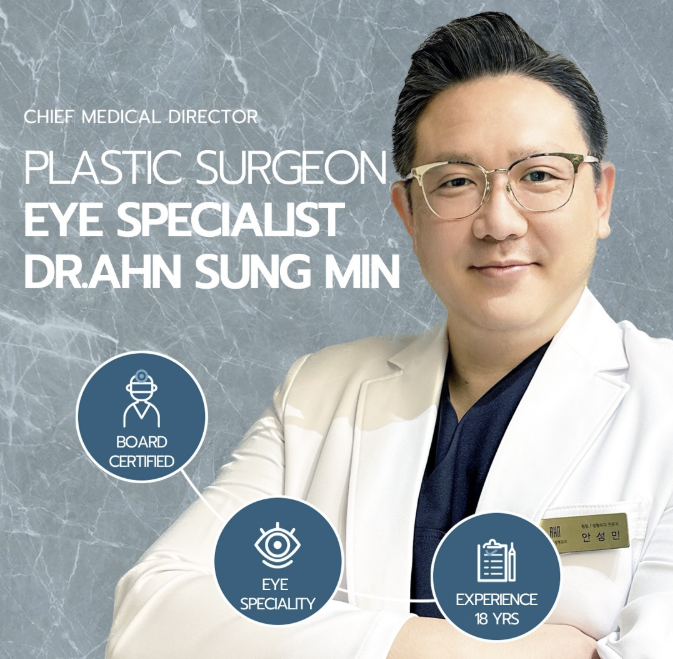
Revision Blepharoplasty by Dr. Ahn Sung Min
Revision eye surgery in Korea corrects unsatisfactory results from previous eyelid procedures, including double eyelid surgery, ptosis correction, and lower blepharoplasty. At Ahn Sung Min Plastic Surgery Clinic, Dr. Ahn Sung Min carefully analyzes the cause of the problem before creating a personalized revision plan. The goal is to restore natural-looking, balanced, and functional eyelids.
Revision Eye Surgery Korea
Revision eye surgery is performed when patients are dissatisfied with the appearance or function of their previous eyelid surgery.
Because revision procedures involve scar tissue and altered anatomy, they require careful planning and an experienced surgical approach.
Personalized Consultation by Dr. Ahn Sung Min
Every revision patient receives a detailed evaluation.
The examination includes:
- Previous surgical history
- Scar tissue assessment
- Eyelid symmetry
- Double eyelid crease position
- Eyelid opening
- Skin quality
- Remaining tissue
- Eye function
- Facial balance
The treatment plan is customized according to each patient's concerns and previous surgery.
What Can Revision Eye Surgery Correct?
Revision surgery may improve:
- Uneven double eyelids
- Asymmetrical eyelids
- Creases that are too high or too low
- Multiple eyelid folds
- Loose or disappearing double eyelids
- Overcorrected or undercorrected ptosis
- Eye bags after previous surgery
- Hollow under-eyes
- Visible scarring
- Unsatisfactory cosmetic results
The exact procedure depends on the underlying cause of the problem.
Types of Revision Eye Surgery
Depending on the patient's condition, Dr. Ahn Sung Min may perform:
- Revision double eyelid surgery
- Revision ptosis correction
- Revision lower blepharoplasty
- Under-eye fat repositioning
- Scar revision
- Eyelid symmetry correction
- Tear trough correction
- Upper and lower eyelid revision
Every revision procedure is individually planned rather than following a standard technique.
Benefits of Revision Eye Surgery
Revision surgery may help:
- Restore eyelid symmetry
- Improve eyelid function
- Create natural-looking eyelid creases
- Correct eye bags
- Improve tear troughs
- Reduce visible scarring
- Refresh facial appearance
- Increase patient satisfaction
The goal is to achieve balanced, natural-looking results while preserving healthy eyelid function.
Who Is a Good Candidate?
Revision eye surgery may be recommended for patients with:
- Unsatisfactory previous eyelid surgery
- Asymmetrical eyelids
- Persistent ptosis
- Multiple eyelid folds
- Eye bags after surgery
- Hollow lower eyelids
- Functional eyelid problems
- Stable healing after previous surgery
Patients should generally allow sufficient healing after their initial surgery before considering revision unless early correction is medically necessary.
Recovery After Surgery
Recovery depends on the complexity of the revision procedure.
Most swelling and bruising improve within one to two weeks, while final results continue to refine over several months as scar tissue softens.
Regular follow-up appointments are important throughout the healing process.
International Patients
International patients may request an online consultation before traveling to Korea.
Recommended photographs include:
- Front view
- Side view
- Eyes open
- Eyes closed
- Looking upward
- Smiling
Patients should also provide:
- Previous operative records if available
- Before-and-after photographs
- Previous surgical history
- Medical conditions
- Current medications
The final surgical plan is confirmed during the in-person consultation.
Why Choose Ahn Sung Min Plastic Surgery Clinic?
Revision eyelid surgery requires specialized expertise because every case is unique.
The clinic offers:
- Advanced revision eye surgery
- Revision double eyelid surgery
- Revision ptosis correction
- Revision lower blepharoplasty
- Personalized surgical planning
- Scar tissue management
- Natural-looking correction
- International patient care
Frequently Asked Questions
What is revision eye surgery?
Revision eye surgery corrects cosmetic or functional problems following previous eyelid surgery.
Why do patients need revision surgery?
Patients may seek revision because of asymmetry, an unnatural crease, recurrent ptosis, persistent eye bags, scarring, or dissatisfaction with previous results.
Can revision double eyelid surgery improve uneven eyelids?
Yes. Revision surgery can improve eyelid symmetry, crease height, crease shape, and overall balance.
Can ptosis surgery be revised?
Yes. Revision ptosis correction may improve eyelid height, symmetry, and eyelid function after previous surgery.
Can lower eyelid surgery be revised?
Yes. Revision lower blepharoplasty can address persistent eye bags, hollow under-eyes, contour irregularities, or asymmetry.
Is revision surgery more difficult than primary surgery?
Yes. Scar tissue and previous surgical changes make revision surgery more complex and require individualized planning.
When can revision surgery be performed?
Most patients should wait until healing from the previous surgery is complete before undergoing revision, unless earlier correction is medically appropriate.
Will the results look natural?
The goal is to restore balanced, natural-looking eyelids that complement the patient's facial features.
How long is recovery?
Most swelling and bruising improve within one to two weeks, while final refinement continues over several months.
Can international patients receive an online consultation?
Yes. International patients can submit photographs and previous surgical information for a preliminary evaluation before traveling to Korea.
How long should international patients stay in Korea?
The recommended stay depends on the type of revision procedure and postoperative follow-up schedule.
Can more than one problem be corrected during revision surgery?
Yes. When appropriate, multiple concerns such as asymmetry, ptosis, eye bags, and scar revision may be addressed during the same procedure.